Kingsley Group Governance Architecture Research The Governance Gap in Dental Organizations
Structural Authority Challenges in Expanding Multi-Location Practices
Institutional Analysis
SECTION I — INSTITUTIONAL CONTEXT
Over the past two decades, the structural landscape of dental organizations has undergone a significant transformation. What were once primarily single-practice clinical environments have increasingly evolved into multi-location enterprises operating across regional and national markets. This shift has introduced new forms of organizational complexity. Clinical teams expand, affiliated practices are integrated, and leadership roles diversify across both clinical and operational domains.
As organizations scale beyond a small cluster of practices, leadership structures tend to evolve organically. Founding clinicians frequently transition into broader leadership positions. Regional directors, clinical leads, operations managers, and integration teams are introduced to coordinate growth across expanding geographic footprints. Each new layer adds capacity to manage a larger enterprise, but it also multiplies the number of relationships through which authority must be exercised.
In early stages of organizational development, authority relationships are often informal yet effective. Decision pathways remain visible because the leadership structure is relatively compact. Founders, practice leaders, and early executives frequently maintain direct oversight across most operational and clinical domains. Within this environment, many decisions can be resolved quickly through personal knowledge of the organization and close communication among leadership.
As organizations grow, however, this informal structure becomes increasingly difficult to sustain. The number of clinical teams expands, operational departments multiply, and leadership responsibilities distribute across a wider group of individuals. Practices may be acquired in different regions, each bringing its own internal culture and operational norms. New executives join to support scaling infrastructure. The resulting structure becomes increasingly layered and geographically distributed.
Within this context, governance architecture begins to assume a more significant institutional role. Governance architecture refers to the structural framework through which authority is defined, decision rights are situated, and accountability boundaries are established within an organization. While operational processes and clinical protocols guide day-to-day activity, governance architecture determines how authority is recognized and exercised across the enterprise.
In small organizations, governance architecture may remain largely implicit. Founders and early leaders often embody the decision logic of the organization through their direct involvement. As the enterprise expands, however, the absence of explicit authority design can gradually introduce uncertainty into the organization’s internal structure. Decision pathways become less visible, escalation patterns become less predictable, and leadership roles begin to overlap in subtle ways.
It is within this transitional environment that a recurring structural phenomenon emerges.
SECTION II — EMERGENCE OF THE GOVERNANCE GAP
Many expanding organizations encounter a stage in which structural complexity begins to outpace the clarity of authority relationships. Leadership layers increase, responsibilities distribute across new roles, and decision-making becomes more dispersed across locations and teams. Yet the underlying architecture that defines authority boundaries may still reflect an earlier stage of organizational design.
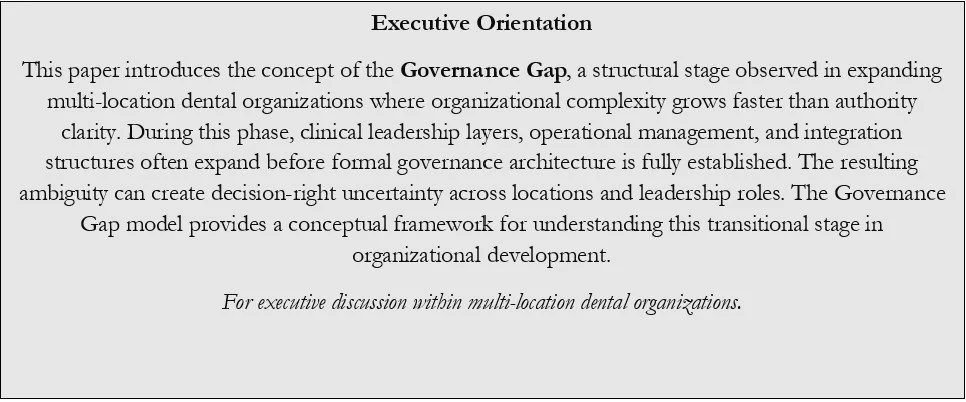
This stage can be described as the Governance Gap.
The Governance Gap refers to a structural phase in which organizational complexity expands faster than governance architecture clarity. Authority relationships multiply as new leadership positions are introduced, but the explicit definition of decision rights and accountability boundaries may not expand at the same pace.
CORE OBSERVATION
The Governance Gap is not a leadership failure.
It is a structural lag that can emerge when organizational scale expands faster than explicit authority design.
Importantly, the Governance Gap should not be interpreted as a failure of leadership or management. In many organizations, it emerges precisely because growth is occurring successfully. Expansion across markets, integration of new practices, and the development of regional leadership roles all reflect progress toward a larger enterprise structure. The Governance Gap simply reflects the structural lag that can occur when institutional infrastructure develops more slowly than the organization itself.
During this phase, organizations often continue to operate effectively, yet subtle forms of ambiguity begin to appear. Decision-making authority may vary across locations. Leaders may rely on informal escalation patterns to resolve uncertainty. Founders or senior executives may remain involved in decisions that earlier organizational models assumed they would eventually delegate.
Because these dynamics tend to emerge gradually, they are often interpreted as operational challenges rather than structural ones. Leadership teams may attribute recurring decision friction to communication issues, personnel changes, or integration complexity. In many cases, however, the underlying pattern reflects a broader shift in organizational scale.
As enterprises transition from founder-centered structures toward multi-layered leadership environments, authority relationships must eventually be articulated more explicitly. Without this transition, organizations may experience a widening gap between how authority is exercised in practice and how it is formally understood within the enterprise.
The concept of the Governance Gap provides a lens for understanding this stage of development.
SECTION III — THE GOVERNANCE GAP MODEL
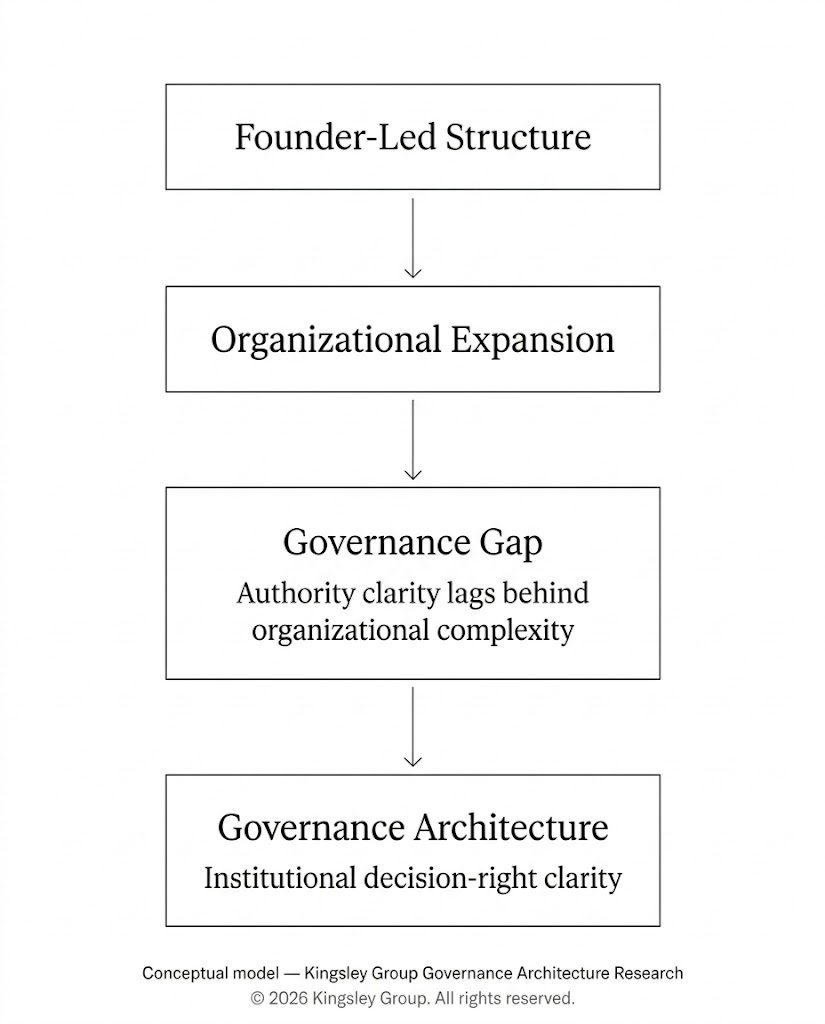
The structural evolution of many expanding dental organizations can be understood as a progression through several recognizable developmental stages.
In the earliest stage, authority relationships tend to revolve around the founding leadership group. Decisions are centralized, communication pathways are direct, and most operational or clinical issues can be resolved through close proximity among decision makers.
As the organization enters a growth phase, expansion introduces additional leadership layers. Regional oversight roles, operational management structures, and clinical leadership positions begin to distribute responsibility across the enterprise. This stage often coincides with the integration of newly affiliated practices and the expansion of centralized support infrastructure.
The Governance Gap frequently emerges during this transition. Organizational complexity continues to increase as the enterprise expands, yet the structural clarity of authority relationships may not develop at the same pace. Leadership teams operate within a structure that has grown rapidly but whose formal governance architecture remains only partially defined.
Eventually, many mature organizations respond to this complexity by developing more explicit governance architecture. Authority relationships become more formally articulated, decision rights are clarified across leadership layers, and accountability structures are established with greater institutional consistency. Governance architecture becomes a foundational component of organizational infrastructure, enabling the enterprise to sustain scale without relying primarily on informal coordination.
The Governance Gap therefore represents not a permanent condition, but a transitional stage in the structural development of expanding organizations.
SECTION IV — SIGNALS ORGANIZATIONS MAY BE ENTERING THE GAP
Because the Governance Gap reflects a structural pattern rather than a discrete event, organizations may enter this stage gradually. The transition often occurs as leadership roles multiply and operational complexity increases across locations.
Several observable dynamics may indicate that an organization is moving into this stage of development.
Clinical leadership layers may expand without clearly defined authority boundaries between regional directors, local lead dentists, and executive clinical leadership. Each role may carry significant responsibility, yet the precise scope of decision authority across these roles may remain partially implicit.
Operational escalation patterns may also shift. Decisions that once occurred at the practice or regional level may begin to move upward toward senior executives or founding leaders. This escalation does not necessarily reflect a lack of capability among emerging leaders; rather, it can signal uncertainty about where decision rights formally reside.
Integration of newly affiliated practices may introduce additional variation in how decisions are made across locations. Legacy practice cultures, historical leadership arrangements, and differing operational systems can create subtle differences in decision logic across the organization.
Founders and early executives may also experience increasing involvement in operational decisions that the organization had expected to distribute more broadly. As the enterprise grows, these leaders may remain informal reference points for resolving uncertainty across the leadership structure.
Taken individually, these dynamics may appear routine within expanding organizations. Viewed collectively, however, they can indicate that authority clarity is beginning to lag behind organizational scale.
Illustrative Indicators
Organizations may be entering the Governance Gap when:
• decision authority becomes unclear across clinical leadership layers
• regional leaders escalate routine operational decisions to founders or executive leadership
• integration of newly affiliated practices introduces inconsistent decision logic
• clinical oversight responsibilities become distributed without formal authority definitions
These indicators do not imply organizational weakness. On the contrary, they often arise precisely because the enterprise is expanding successfully. They simply reflect the structural adjustments that accompany growth in leadership layers and operational complexity.
SECTION V — GOVERNANCE ARCHITECTURE AS INSTITUTIONAL INFRASTRUCTURE
As dental organizations continue to scale, many eventually develop governance architecture that reflects the size and complexity of the enterprise. In this stage, authority relationships are no longer primarily maintained through informal coordination or historical precedent. Instead, they become embedded within the organization’s institutional design.
Governance architecture can be understood as the structural framework through which authority is organized across leadership layers. It encompasses the explicit definition of decision rights, the delineation of accountability boundaries, and the structural relationships between clinical and operational leadership roles.
Within mature organizations, governance architecture performs a role similar to other forms of institutional infrastructure. Financial systems provide visibility into economic performance, while clinical protocols guide patient care. Governance architecture establishes the internal logic through which decisions are situated across the enterprise.
When authority relationships are clearly articulated, leaders across the organization can understand the scope of their responsibilities without relying primarily on informal interpretation. Decision pathways become more predictable, escalation patterns become more structured, and accountability boundaries become easier to recognize across locations.
This structural clarity also supports organizational continuity. As leadership teams evolve and new practices join the enterprise, governance architecture provides a stable framework within which authority relationships can operate. Rather than relying on individual personalities or historical precedent, the organization’s authority design becomes embedded within its institutional structure.
In this sense, governance architecture functions not merely as an administrative mechanism but as an element of organizational infrastructure. It enables expanding enterprises to sustain complexity while preserving clarity in how authority is exercised across the organization.
Closing Reflection
As dental organizations continue to expand across markets and integrate larger networks of affiliated practices, the structural clarity of authority relationships becomes increasingly significant. Growth introduces new leadership layers, operational systems, and integration processes, each of which contributes to the complexity of the enterprise.
The Governance Gap model offers a conceptual lens for understanding a transitional stage that many expanding organizations encounter. By recognizing the point at which authority clarity begins to lag behind organizational scale, leadership teams can better interpret the structural dynamics that accompany growth.
Viewed in this way, the Governance Gap represents a recognizable stage in the institutional development of expanding dental organizations.
Originally published by
Kingsley Group
Institutional Governance Publications for Dental Leadership
Permission to circulate internally for executive discussion.
Not for resale or public redistribution.