Integrated assisted hygiene governance architecture system establishing departmental authority visibility, accountability continuity, supervision clarity, and institutional structural stability across assisted hygiene clinical delivery environments.
Positions assisted hygiene governance as a permanent leadership function rather than an operational initiative — addressing the structural conditions that determine how authority, delegation, and accountability remain clear as assisted hygiene capacity expands across single and multi-location organizations.
Structured across four governance architecture tiers:
Tier 1 — Governance Foundations: Establishes baseline authority positioning, delegation clarity, and accountability structure for assisted hygiene environments prior to structural scaling or departmental expansion.
Tier 2 — Architecture & System Design: Examines the structural design of assisted hygiene governance architecture — how authority relationships are organized, how delegation models are structurally integrated, and how supervision accountability is maintained across multi-provider environments.
Tier 3 — Execution, Implementation & Control: Addresses governance architecture during implementation and scaling phases — how authority visibility is maintained as assisted hygiene capacity expands, how accountability boundaries remain structurally clear under operational pressure, and how governance integrity is preserved during growth.
Tier 4 — Operations & Sustainment: Examines long-term governance architecture for mature assisted hygiene environments — how institutional authority remains visible through leadership transitions, staffing changes, and evolving clinical delivery models.
Included publications: Assisted Hygiene Governance Foundations — Assisted Hygiene Architecture & System Design — Assisted Hygiene Execution, Implementation & Control — Assisted Hygiene Operations & Sustainment
Integrated assisted hygiene governance architecture system establishing departmental authority visibility, accountability continuity, supervision clarity, and institutional structural stability across assisted hygiene clinical delivery environments.
Positions assisted hygiene governance as a permanent leadership function rather than an operational initiative — addressing the structural conditions that determine how authority, delegation, and accountability remain clear as assisted hygiene capacity expands across single and multi-location organizations.
Structured across four governance architecture tiers:
Tier 1 — Governance Foundations: Establishes baseline authority positioning, delegation clarity, and accountability structure for assisted hygiene environments prior to structural scaling or departmental expansion.
Tier 2 — Architecture & System Design: Examines the structural design of assisted hygiene governance architecture — how authority relationships are organized, how delegation models are structurally integrated, and how supervision accountability is maintained across multi-provider environments.
Tier 3 — Execution, Implementation & Control: Addresses governance architecture during implementation and scaling phases — how authority visibility is maintained as assisted hygiene capacity expands, how accountability boundaries remain structurally clear under operational pressure, and how governance integrity is preserved during growth.
Tier 4 — Operations & Sustainment: Examines long-term governance architecture for mature assisted hygiene environments — how institutional authority remains visible through leadership transitions, staffing changes, and evolving clinical delivery models.
Included publications: Assisted Hygiene Governance Foundations — Assisted Hygiene Architecture & System Design — Assisted Hygiene Execution, Implementation & Control — Assisted Hygiene Operations & Sustainment
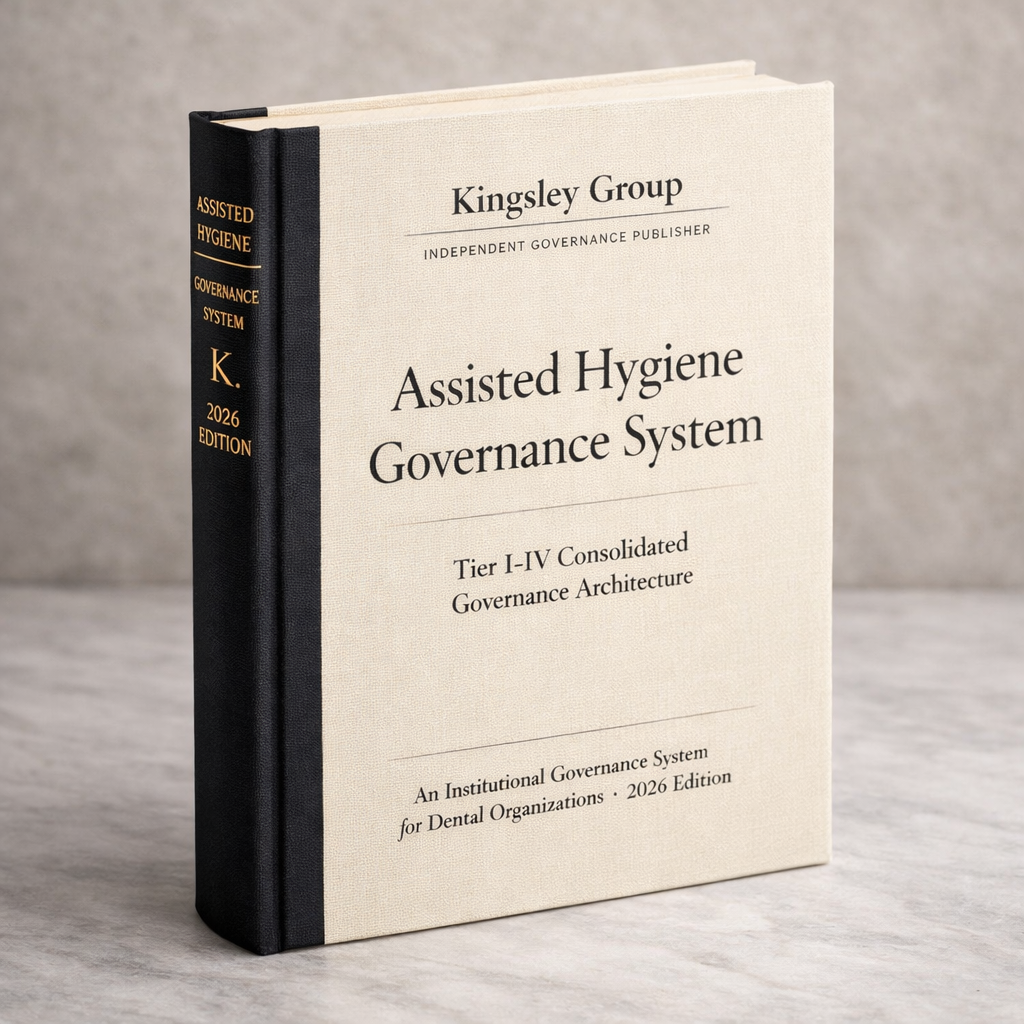 Image 1 of 1